
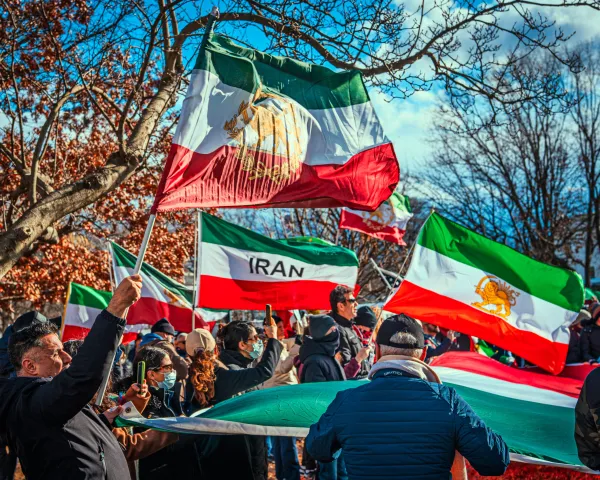
The existence of such a brutal regime that plants seeds of violence and terror in the world should have no place to dig roots, Atisa Khalaj writes. [Photo by Ted Eytan]
Since the outbreak of war on February 28, 2026, between the United States, Israel, and Iran, renewed attention has focused on resistance to the Iranian regime, particularly within diasporic Iranian communities and international media spheres. Public figures—some Iranian, many not—have spoken in solidarity. They post statements, deliver award-show remarks, share symbolic gestures, and call for international awareness. These interventions are often sincere. In some cases, they carry personal risk. Yet their prominence reveals a deeper tension: the growing tendency for political movements to be understood primarily through the voices of those who are already visible.
The difficulty is not celebrity participation as such. Public figures have long lent their voices to political causes. The problem emerges when visibility itself begins to organize political authority—when recognition substitutes for representation, and when the most amplified voices are treated, implicitly, as the most authoritative. Under contemporary media systems, fame does not merely amplify political struggle; it shapes how struggle becomes intelligible.
I call this dynamic celebratism: not celebrity activism itself, but a broader media condition in which visibility functions simultaneously as attention, credibility, and political currency. Under celebratism, movements are not silenced. They are translated. Translation is not neutral.
Every act of mediation selects, compresses, and rearranges. Political struggles rooted in institutional conflict, economic power, and political structure travel globally more easily as moral narratives of courage and oppression. “Freedom,” “women’s rights,” “hope”: these are indispensable words, and they are not wrong. But they are indeterminate. They gesture toward transformation without specifying its political architecture.
During the Woman, Life, Freedom protests, symbolic acts circulated internationally with extraordinary speed: celebrities cutting their hair on camera, viral declarations of solidarity, carefully staged performances of identification. Such gestures generated visibility for repression inside Iran, but they also revealed how quickly complex political struggles can be reformatted into emotionally legible narratives optimized for circulation. What traveled most effectively across platforms was often what was least institutionally specific.
This dynamic reflects more than individual behavior. It emerges from media infrastructures organized around algorithmic visibility, speed, and engagement. Platforms reward immediacy over duration, emotional clarity over institutional complexity, and personal identification over structural analysis. Under such conditions, politics increasingly appears as image, slogan, and statement. Visibility becomes both currency and proof of seriousness.
Yet the uprising in Iran has never been reducible to symbolism alone. It has involved demands tied to institutional transformation: curtailing the authority of unelected bodies, confronting the political and economic power of the Revolutionary Guard, securing labor protections, and establishing accountability for state violence. These are structural ambitions. They concern law, bureaucracy, sovereignty, and the organization of political power itself. Political transformation depends not simply on recognition, but on capacities capable of reshaping institutions: labor organization, durable networks, political reform, and sustained collective risk.
As these demands circulate through English-language media ecosystems governed by speed, affect, and visibility, they risk becoming emblematic rather than institutional. Diasporic publics often become intermediaries in this process, translating internal struggles into internationally legible narratives capable of attracting attention abroad. Such translation can be necessary. It can also flatten political specificity in order to achieve circulation.
This contraction of complexity is not the fault of any one individual. It reflects the broader logic of contemporary publicity and platform capitalism. A viral slogan travels farther than a debate over political reform. A symbolic gesture circulates more rapidly than the organizational work required to sustain strikes, labor coordination, or political networks capable of enduring repression.
Public figures possess platforms; movements possess accountability.
The distinction matters. Activists inside Iran are answerable to neighbors, co-workers, and fellow organizers. They confront consequences that cannot be exited. Their political authority emerges, insofar as it exists, from embedded risk and shared vulnerability. Celebrities, by contrast, derive authority from symbolic capital accumulated elsewhere—on screens, stages, and digital platforms. Their recognition precedes the causes they endorse.
This asymmetry does not render celebrity solidarity illegitimate. International attention can deter abuses, influence diplomatic calculations, and sustain diasporic networks of support. For movements confronting authoritarian repression, invisibility can be deadly. The question is not whether amplification helps. It is how amplification reorganizes what is being amplified—and whether visibility begins to substitute for political power itself.
When political struggle is refracted primarily through celebrity speech, its grammar begins to shift. Conflict becomes narrated through personal identification: why I care, what this means to me, how this reflects my values. Such declarations can widen circles of empathy. But they also risk recentering the speaker. The movement becomes a backdrop for personal positioning. Endorsement begins to resemble leadership.
Over time, this recalibrates assumptions about who counts as a political subject. Fame acquires the appearance of representation. Popularity begins to function as legitimacy. Structural confrontation softens into symbolic alignment. Demands requiring institutional upheaval give way to sentiments inviting universal assent.
There is a temptation—especially among observers geographically distant from the conflict—to welcome any attention as inherently beneficial. But attention is never neutral. It possesses a form. It privileges certain kinds of speech over others. It rewards immediacy, emotional clarity, and moral legibility. Meanwhile, the slower forms of politics—organizing workplaces, coordinating resistance, sustaining networks of trust, debating reform futures—remain far less visible despite being far more consequential.
For those inside Iran, politics is not an aesthetic performance but a material risk. Arrest is not metaphorical. Reprisal is not symbolic. The future is not an abstraction. When international attention fades—as it inevitably does—these realities remain. Public figures can recalibrate their commitments as cultural attention shifts. Those embedded within the struggle cannot.
None of this implies that celebrities should remain silent. Nor does it suggest that movements can withdraw from the infrastructures through which recognition travels. In a world organized by platforms, visibility is unavoidable. Politics requires witnesses. It requires translation across borders. It requires solidarity.
But the distinction between amplification and direction must remain clear. To amplify is to extend visibility. To direct is to shape strategy, define goals, and determine priorities. The former can be an act of solidarity. The latter requires political accountability. The task, then, is not to purify struggle from mediation, but to resist the quiet slide by which mediation becomes sovereign. Justice for those resisting authoritarianism in Iran is not a brand or an image. It is organization, endurance, and the difficult reconstruction of political life.
What endures after publicity fades is not visibility itself, but the institutions, solidarities, and risks that visibility can never substitute for.